
THE TEACHER EMPOWERMENT BOOTCAMP
Building Skills, Confidence & Connection for the Modern Classroom
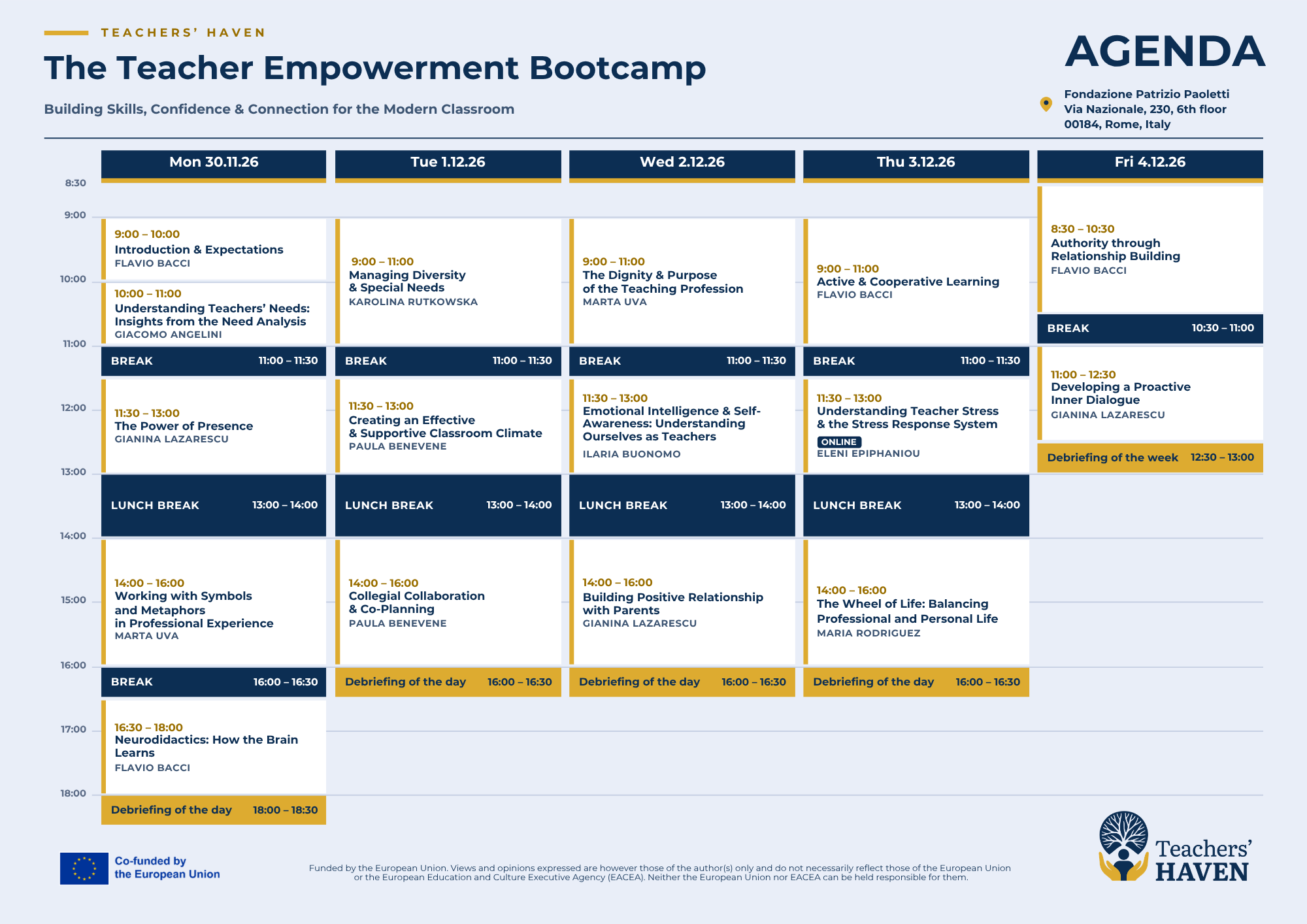
Teachers’ Haven: The Teacher Empowerment Bootcamp is a five-day professional development course designed for novice, trainee and in-service teachers from European countries who want to strengthen both their teaching practice and their personal resources as educators.
The course addresses some of the key challenges teachers face in today’s classroom: managing diverse learning needs, creating positive and supportive classroom environments, building constructive relationships with students and parents, maintaining motivation and professional purpose, and managing the emotional demands of the teaching profession.
During a five-day training, participants will explore practical approaches to active and cooperative learning, classroom climate, relationship-building, communication, emotional intelligence, teacher well-being and stress management. The course combines expert input with interactive exercises, individual reflection, group activities, discussion and practical application.
Learn more
Participants will begin by exploring teachers’ current needs and challenges and reflecting on the role, dignity and purpose of the teaching profession. They will then develop practical strategies for creating inclusive and supportive learning environments, including approaches to managing diversity and special educational needs, strengthening teacher authority through relationships, and using presence and communication effectively in the classroom.
The course also focuses on the teacher as a person. Through sessions on emotional intelligence, self-awareness, inner dialogue, stress and the stress-response system, participants will examine how their own emotional states, beliefs and reactions can influence their professional practice. Creative and reflective activities, including healing through art and creative expression and the Wheel of Life, will support participants in identifying personal resources, sources of stress and areas for professional and personal development.
A further focus is placed on evidence-informed teaching and learning. Participants will explore how the brain learns through neurodidactics and consider how this knowledge can inform classroom practice. Sessions on active and cooperative learning, collegial collaboration and co-planning will provide opportunities to explore concrete approaches that can be transferred to participants’ own educational contexts.
The course also addresses the wider relationships that shape a teacher’s work. Participants will explore strategies for building positive relationships with parents and collaborating effectively with colleagues, recognising that supportive professional networks and constructive communication are important elements of an effective learning environment.
The international group provides an additional opportunity for professional exchange. Participants will be encouraged to share examples from their own schools and countries, compare approaches and learn from the experiences of other educators. This creates space not only to acquire new tools, but also to critically reflect on existing practices and identify approaches that can be adapted to different classroom realities.
Unlock your potential – join the The Teacher Empowerment Bootcamp!
Dates:
Monday, 30 November – Friday, 4 December 2026
Organiser:
Fondazione Patrizio Paoletti
Learn more
An Italian nonprofit foundation and research center focused on education, neuroscience, psychology, and pedagogy. It develops innovative training programmes aimed at supporting personal development, emotional well-being, and professional growth for educators and other professionals.
In-person – on-site
Location:
Fondazione Patrizio Paoletti
Via Nazionale, 230, 6th floor
00184 Rome, Italy
Who can participate?
Novice and in-training teachers, primary and secondary-school teachers already in profession and all educators interested in participating.
Specifications
Material Required: Bring your laptop
Certificate: Yes – Europass Certification & Course Completion Certificate
Price
Participation in the course is free of charge.
Free of chargeLearning outcomes
By the end of the course participants will:
- Practise a short present-moment awareness exercise.
- Explain the difference between automatic and intentional attention using a concrete teaching-related example.
- Identify one reactive inner dialogue pattern in a realistic teaching-related situation.
- Reformulate a reactive inner statement into a proactive, self-guiding statement.
- Identify communication triggers and potential escalation points in realistic parent–teacher situations.
- Apply appropriate communication strategies to formulate clear and respectful responses to parents.
Show more (+30)Show less
- Demonstrate how professional boundaries can be maintained while supporting constructive collaboration with families.
- Analyse a traditional lesson segment to identify points of cognitive overload, attentional decline and missed retrieval opportunities.
- Redesign a lesson micro-plan by integrating neurodidactic principles, with an explicit rationale for each change.
- Design a short instructional segment for their own subject and school level, and refine it through structured peer feedback.
- Analyse classroom scenarios to recognise authoritarian, permissive and relational postures and their effect on student engagement and behaviour.
- Conduct a restorative conversation in a simulated conflict situation, setting clear boundaries while keeping the relationship intact.
- Design a relational classroom contract that frames rules as shared commitments and includes restorative responses.
- Redesign a short frontal explanation as an active cooperative micro-structure, defining timing, roles, facilitation prompts and evidence of re-elaboration.
- Facilitate a cooperative activity with peers and respond to typical challenges such as unequal participation, off-task groups or dominant students.
- Design a cooperative task that builds positive interdependence and individual accountability.
- List two personal and two contextual sources of stress
- Label one physiological or emotional stress reaction they experience.
- Identify the main personal and professional needs emerging from the quantitative and qualitative evidence.
- Distinguish individual, relational, and organizational factors that may affect teachers' well-being and professional functioning.
- Connect at least one finding from the needs analysis to their own educational or professional context.
- Identify key elements of a positive classroom climate, including emotional safety, respectful interaction, participation, and predictability.
- Analyse a classroom situation and distinguish practices that support a constructive climate from practices that may increase tension, disengagement, or exclusion.
- Select or design one feasible classroom routine or micro-action to strengthen belonging, participation, and constructive behaviour.
- Distinguish productive collaboration from superficial or poorly structured collegial contact.
- Apply a simple co-planning or team-meeting structure to a realistic school scenario.
- Define one practical action that could strengthen collaboration or co-planning in their own educational context.
- Identify key components of emotional intelligence in a teaching-related situation.
- Recognise and name their own emotional response to a classroom or professional scenario.
- Use a simple trigger-emotion-response framework to reflect on the difference between an automatic reaction and an intentional professional response.
- Complete a simplified Wheel of Life exercise.
- Identify one life area requiring rebalancing.
- Identify common barriers to participation and learning in diverse classrooms.
- Apply inclusive classroom management strategies supporting students with diverse educational needs.
- Adapt simple learning activities using accessible differentiation and UDL-informed techniques.
- Reflect on how inclusive practices influence classroom climate, student participation, and teacher self-efficacy
Learning objectives
By the end of the session, participants will:
- understand some core principles of inclusive teaching and classroom participation.
- apply simple and accessible strategies supporting diverse learners in everyday classroom practice.
- strengthen confidence in managing heterogeneous classrooms through flexible and sustainable inclusive practices.
- Understand present-moment awareness as a practical self-regulation skill in teaching and teacher-training contexts.
- Explore habitual attentional patterns, including distraction, rumination and anticipatory worry, in professional situations.
- Reflect on how noticing and redirecting attention can support more intentional responses to everyday teaching demands.
Show more (+27)Show less
- Explore the distinction between reactive and proactive inner dialogue in teaching-related situations.
- Understand how internal self-talk can influence emotional responses, professional confidence and decision-making.
- Reflect on the role of proactive inner dialogue in supporting self-guided professional action.
- Understand common sources of tension and communication difficulties in parent–teacher relationships.
- Explore practical strategies for clear, respectful and constructive communication with parents.
- Reflect on the importance of professional boundaries and collaborative approaches in challenging parent–teacher interactions.
- Understand how attention, working memory, memory consolidation and executive functions shape learning in everyday classroom settings.
- Explore evidence-based neurodidactic principles, such as attentional cycling, retrieval practice, spacing and dual coding, and how they translate into concrete instructional choices.
- Reflect critically on common beliefs about the brain and learning, distinguishing neuroscience-informed practice from popular neuromyths.
- Understand how the quality of the teacher–student relationship underpins legitimate and effective classroom authority.
- Explore relational strategies, such as emotional availability, autonomy support, shared expectations and restorative communication, that build trust-based authority without coercion or permissiveness.
- Reflect on their own relational posture with students, especially in moments of conflict and boundary-setting.
- Understand the difference between generic group work and structured cooperative learning, and why student re-elaboration leads to deeper learning than passive listening.
- Explore simple cooperative micro-structures, such as Think–Pair–Share, structured triads and role-based groups, that can replace a traditional explanation phase.
- Reflect on the teacher's role as a facilitator of participation and on how cooperative strategies shape classroom climate.
- Become familiar with the main findings of the Teachers' HAVEN cross-national needs analysis on teachers' well-being, professional self-efficacy, work engagement, social support, and training needs.
- Reflect on common and context-specific challenges reported by in-service and in-training teachers across the participating countries.
- Understand how the needs analysis informed the design of the Teachers' HAVEN training pathways.
- Understand the key dimensions of an effective and supportive classroom climate and their relevance to learning, inclusion, and emotional safety.
- Explore relational, organizational, and communication strategies that foster respectful behaviour, participation, and a sense of belonging.
- Reflect on classroom climate as a resource for teachers' professional well-being and sense of effectiveness.
- Understand collegial collaboration as a structured professional practice based on shared responsibility, purposeful communication, and co-planning.
- Explore practical tools for teamwork, peer exchange, and joint decision-making in school settings.
- Reflect on supportive collegial relationships as a resource for professional well-being, self-efficacy, and reduced professional isolation.
- Introduce emotional intelligence and self-awareness as professional competences in teaching.
- Support participants in recognising emotions, triggers, and personal responses in challenging educational situations.
- Encourage reflection on how emotional awareness can support more intentional professional responses and relational well-being.
Mr Flavio Bacci
is a learning designer, soft skills trainer and coach, and has collaborated with Fondazione Patrizio Paoletti, Rome, since 2013 on training design, educational supervision and European projects. Holding degrees in Physics and in Education Sciences, he taught mathematics and physics in secondary schools for over ten years and led educational services for children and adolescents. As a learning expert, he designs classroom, blended and e-learning pathways, including the use of AI to support learning, and trains professionals in communication, emotional intelligence and teamwork; he is a certified coach and Six Seconds EQ Assessor. Within Teachers’ HAVEN, he is project manager of WP4, the professional development pathway on teachers’ self-efficacy and professional versatility.
Giacomo Angelini
PhD, is a researcher in Developmental and Educational Psychology and a member of the LUMSA University team in the Teachers’ HAVEN project. His research focuses on teachers’ and adolescents’ well-being, with particular attention to burnout, work engagement, self-efficacy, school-related well-being, and career development. Within Teachers’ HAVEN, he contributed to the cross-national needs analysis on teachers’ personal and professional development needs and to the development of training materials supporting teacher well-being and professional growth.
Ilaria Buonomo
is an Associate Professor of Work and Organizational Psychology at LUMSA University, Rome. Her research focuses on well-being in educational and organizational contexts, with particular attention to compassion, emotional regulation, work engagement, burnout, and supportive relational resources. She has developed and contributed to evidence-based training on stress management, burnout prevention, and well-being for helping professionals. Within Teachers’ HAVEN, she contributes to the personal development pathway on emotional intelligence, self-awareness, and teachers’ psychological well-being.
Professor Paula Benevene
is a Full Professor of Work and Organizational Psychology at LUMSA University, Rome. Her research focuses on organizational well-being, human resource development, workplace learning, and sustainability in organizations. Her work examines the personal, relational, and organizational conditions that support healthy workplaces, professional development, and sustainable professional practices. Within Teachers’ HAVEN, she contributes to the professional development pathway on supportive classroom environments and collegial collaboration.
Gianina Lazarescu
holds a PhD in Psychology and is an Assistant Professor in the Department of Psychology at the West University of Timișoara, Romania. She is also a Clinical Psychologist and a Systemic Family and Couple Psychotherapist. Her academic and professional work focuses on clinical and health psychology, family and couple relationships, parent-child dynamics, emotional and relational functioning, and mental health. She teaches in undergraduate Psychology and Cognitive Science programmes and coordinates practical psychotherapy training activities at master’s level. Within the Erasmus+ Teachers‘ HAVEN project, she represents ATFCT and coordinates WP3 – Personal Development Programme, overseeing the development of its methodological framework and educational materials focused on teachers‘ emotional well-being, self-regulation, self-efficacy and professional development.
Karolina Rutkowska, MA
Special Education Teacher | Early Childhood Educator | Teacher Trainer | Director of Reggio Emilia-inspired Preschools
Karolina Rutkowska, MA is a special education teacher, early childhood educator, teacher trainer and educational leader. Since 2016, she has been the founder and director of non-public preschools inspired by the Reggio Emilia approach and the owner of early childhood education centres in Poland. She also works as a special education teacher in preschool settings, an early primary school teacher and a revalidation specialist in a primary school. Karolina leads parent support groups, delivers professional development workshops for educators and parents, and is a certified Social Skills Training (TUS) trainer. Since October 2024, she has been teaching undergraduate students in Early Childhood and Preschool Education at Lublin University WSEI. Her professional interests focus on inclusive education, neurodiversity, relationship-based education, learning communities and teacher self-efficacy. She believes that inclusive education begins with relationships and that strong learning communities are built through everyday acts of participation, shared responsibility and equal dignity.
Marta Uva
is a lecturer at the School of Education of the Polytechnic Institute of Santarém (ESE-IPSantarém), where she serves as President of the Pedagogical Council and coordinates the Master’s Degree in Pre-School Education. She is also a member of the Ethics Committee of the Polytechnic University of Santarém. She holds a Master’s degree in Educational Sciences from the Portuguese Catholic University, a Bachelor’s degree in Philosophy from the same institution, and the title of Specialist in Educational Sciences – Teacher and Trainer Education. Her teaching and supervision focus on Ethics and Deontology, Citizenship Education, Development Education, and Global Citizenship, particularly in teacher education programmes. She has extensive experience in in-service teacher training, especially in the areas of Citizenship Education and gender equality, collaborating with the Portuguese Directorate-General for Education (DGE) and the Commission for Citizenship and Gender Equality (CIG). She is also a co-author of educational guidebooks, eBooks, and teacher training resources. Marta Uva has participated in several national projects on Gender Equality, Citizenship Education, Development Education, Global Citizenship, and Inclusive Education. Her research interests include teachers’ ethical and deontological education, Philosophy for Children, Citizenship Education, and Development Education. Additional research interests include curriculum development, particularly pedagogical strategies for fostering classroom dialogue and reflective thinking.
Eleni Epiphaniou
began her academic career with a BSc in Psychology from the University of Cyprus, followed by an MSc and PhD in Health Psychology from the University of Surrey. She is a Chartered Health Psychologist and a licensed and registered Psychologist. Her postdoctoral career has focused on applied research in health and healthcare. At King’s College London, she contributed to quantitative and qualitative research projects, including multicentre studies, focusing on chronic illness management, end-of-life care, informal caregiving, and healthcare coordination and collaboration. She subsequently served as Senior Research Assistant at Queen Mary University of London, where she led a systematic review of reviews examining self-management interventions for individuals living with long-term conditions.
Her research focuses on the psychological and social factors that influence adjustment, coping, and behaviour change in the context of chronic illness and health challenges. Her research interests include illness perceptions, resilience, caregiving, stress and stress management, burnout, and the psychosocial processes underlying adaptation to chronic health conditions. Her research has been published in peer-reviewed scientific journals and has contributed to the evidence base informing health policy and practice, particularly in chronic disease management and self-management. She currently serves as Chair of the Department of Psychology and Social Sciences at European University Cyprus.
Maria Rodriguez
is a doctoral researcher at the University of Salamanca’s Faculty of Education—specifically within the Department of Theory and History of Education and the GIPEP research group. Her doctoral research adopts a comparative perspective between Spain and Sweden, focusing on school inspection. Her academic interests encompass education policy and the transformation of public education systems. As part of the ARAS project, she will facilitate the session “The Wheel of Life: Balancing Professional and Personal Life,” which focuses on raising awareness, reflection, and practical strategies for achieving a healthier, more sustainable balance between these two spheres.
Register
Registration is open to two groups of participants:
Teachers’ HAVEN project participants
Participants taking part through the Teachers’ HAVEN project will attend the course as part of the project. Their participation is funded by the Teachers’ HAVEN project, in accordance with the project’s applicable funding arrangements.
Participants joining through Erasmus+ KA1 mobility
Teachers and educators who have been invited to participate may register for the course through their own Erasmus+ KA1 mobility project or accreditation (e.g. under ADU or SCH). Participants use the funding available through their KA1 project to cover eligible mobility costs, such as travel and accommodation, in accordance with the rules of their Erasmus+ project.
The course is free of charge for all participants. No course or participation fee is required.
Registration is open until 15th November 2026.

Funded by the European Union. Views and opinions expressed are however those of the author(s) only and do not necessarily reflect those of the European Union or the European Education and Culture Executive Agency (EACEA). Neither the European Union nor EACEA can be held responsible for them.
Project no: 101196768

